


















Original lyrics written by Barry Arthur Cotton.
Translations created with AI assistance and edited by the author.
Music and vocals generated using AI tools under commercial licenses under platform use terms.
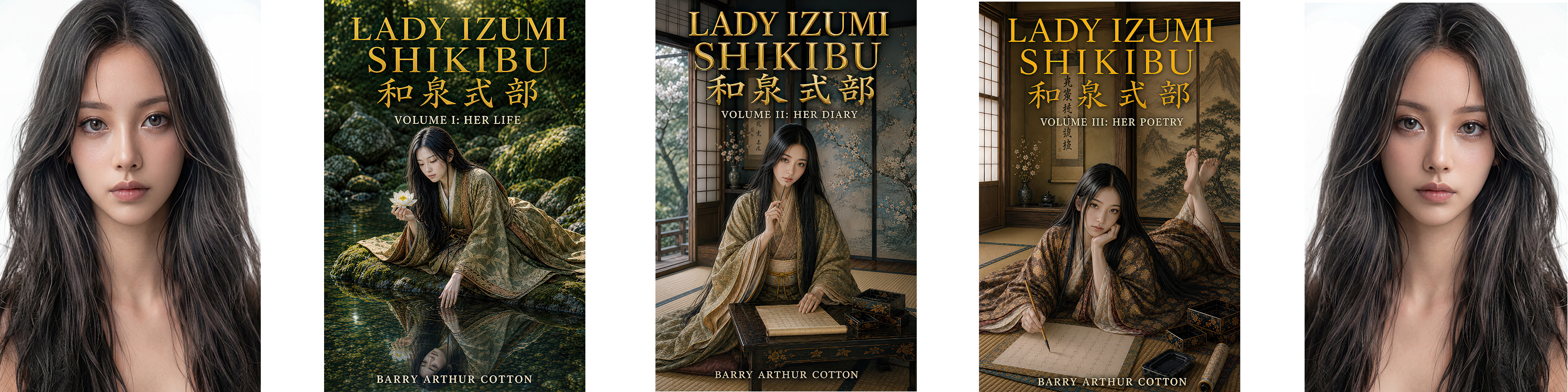
Lady Izumi Shikibu – 和泉式部 (c. 976–after 1033) was born into a mid-ranking but culturally sophisticated court family. Izumi inherited a lineage of bureaucratic learning and poetic fluency.
Her father, Ōe no Masamune (大江匡衡), was governor of Echigo Province and a man of letters; Kyoto provided the rest.1
Educated among elite women, Izumi was trained in calligraphy, perfume, music, and the subtleties of emotional perception. Her 5–7–5–7–7 waka structure is classical. Her late-life renunciation—taking the robes of a lay nun (出家入道)—was not the rejection of desire but its fulfillment.2
She learned, as Buddhist practice teaches, that to cling is suffering, but to feel fully without clinging is wisdom. Her greatest work, the Izumi Shikibu Nikki (和泉式部日記), is neither diary nor fiction, but a poetic memoir composed in the third person—a fusion of prose narrative and waka exchanged with Prince Atsumichi. 3
Her poems appear in more than ten imperial anthologies, including the Shūi Wakashū (拾遺和歌集).
She stands among 女房三十六歌仙 — the Thirty-Six Immortal Women Poets, yet her influence extends far beyond this distinction.4
1. Huey, Robert N. The Making of a Court Society: Heian Japan in the Tenth and Eleventh Centuries. Harvard University Asia Center, 2002
2. Derived from comparative aesthetics: Japanese aware (哀れ) and mujō (無常); Indian rasa (रस) and bhakti (भक्ति); Chinese yijing (意境); Greek lyric intensity (lyrikḗ λυρική); Sumerian ritual poetics (é-mu 𒂍𒈬 / temple-hymnic tradition).
3. McKinney, Meredith. Izumi Shikibu: A Poetic Diary. Columbia University Press, 1996.
4. Mostow, Joshua. Pictures of the Heart: The Hyakunin Isshu in Word and Image. University of Hawaii Press, 1996.